DEVATOP Holds Project Review Meeting Strengthens Collective Action to Protect Child Domestic Workers in Lagos
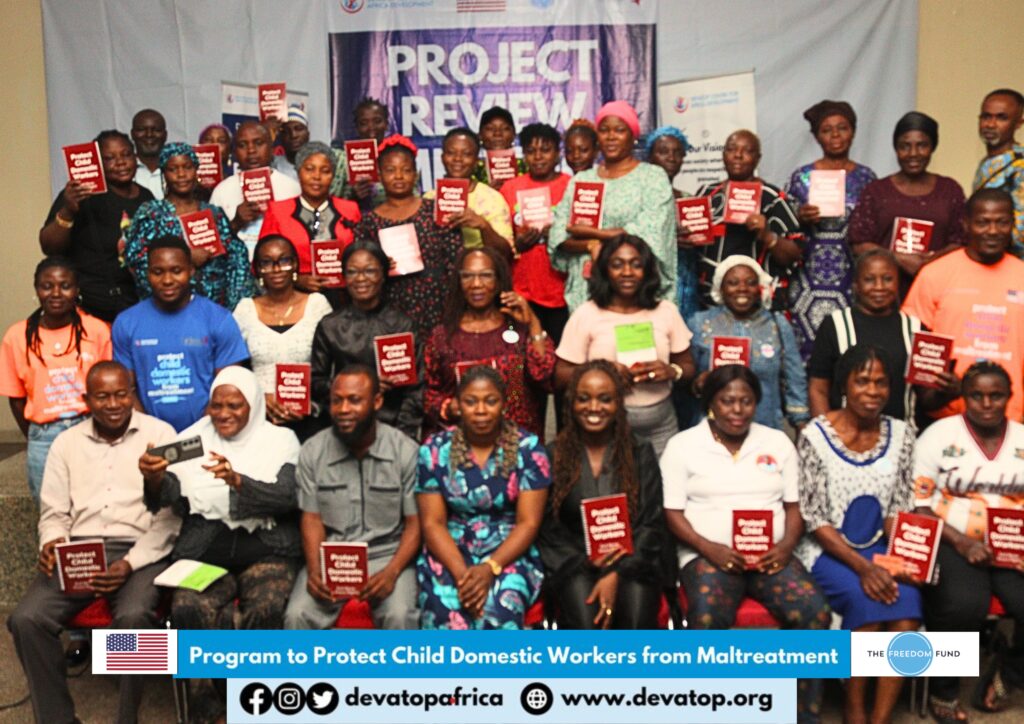
Stakeholders working to end exploitative child domestic work in Lagos State converged on 16 December 2025 at Rockview Hotel, Festac, for a Project Review Meeting aimed at assessing progress, sharing lessons, and strengthening strategies to protect child domestic workers from abuse and exploitation.
The meeting, which commenced at 9:00 a.m., brought together 35 participants comprising representatives of government agencies, civil society organizations, implementing partners, community influencers, and survivors. Participants were welcomed by the moderator, Victor Abba, who appreciated stakeholders for their continued commitment and acknowledged partners including CAPRIGHTS-VP, CECEYARA, and MAJET Nigeria, as well as key institutions such as NAPTIP, HDI, NOA, WAPA, NASOW, and the Child Protection Network.
In her welcome address, the Head of Operations at Devatop Centre for Africa Development, Ms. Akpana Betiang, emphasized the importance of collaboration and shared responsibility in addressing child domestic work. She noted that no case of child exploitation is too small to be addressed and stressed the need to consistently hold perpetrators accountable in order to deter abuse and protect children’s rights.
Goodwill messages from stakeholders reinforced this call. Mrs. Anyebe of the National Association of Social Workers (NASOW), Lagos State, commended Devatop for its sustained efforts to ensure justice for victims of exploitative child domestic work, highlighting NASOW’s commitment to ethical social work practice and child protection. Mrs. Bolanle of the National Orientation Agency (NOA) appreciated the long-standing partnership with Devatop, referencing collaborative activities such as the December 2025 sensitization road walk, and underscored NOA’s mandate to inform and mobilize the public through continuous awareness. Mr. Olamide of NAPTIP echoed the need for collective action, urging stakeholders to prioritize impact over recognition in addressing child exploitation. Representatives of MAJET Nigeria and CECEYARA also reaffirmed their roles as implementing partners, stressing the importance of protecting child domestic workers while preventing stigmatization through inclusive community engagement. Interpretations were provided in Yoruba to ensure inclusivity.
The Project Lead, Janet Homo, presented an overview of the project, addressing common myths and misconceptions surrounding child domestic work in Nigeria. She explained that the project, funded by the Freedom Fund and the United States Government, is implemented in partnership with organizations including MAJET, Slum2School, CAPRIGHTS-VP, CECEYARA, Street Project Foundation, and 3HF. She described child domestic work as one of the most hidden forms of child labour, driven by poverty, loss of parents, and rural–urban migration, and often masked by narratives that portray exploitation as care or opportunity. Janet emphasized that children engaged in domestic work are frequently denied education, rest, safety, and fair treatment, and called for community awareness, enforcement of child protection laws, and collective action to safeguard every child’s dignity and future.
Following a tea break, a detailed project review presentation was delivered by Peculiar Inana, who shared data, achievements, and success stories from the project. She explained that the initiative, implemented by Devatop Centre for Africa Development with support from the Freedom Fund through a grant from the United States Department of State, began its initial phase between October 2023 and December 2024 and scaled up in 2025 across multiple local government areas in Lagos State with six partner organizations. Findings revealed that children typically enter domestic work at an average age of 10, most have kinship ties with their employers or guardians, and nine out of ten experience violations of the Nigerian Labour Act or Child Rights Act, including excessive working hours and violence. Despite these challenges, the project’s interventions—ranging from policy engagement and community sensitization to media advocacy and mentorship—have increased reporting, strengthened collaboration with authorities, and supported rescued children who are now emerging as advocates for change.
 An interactive feedback session followed, during which community influencers from Okoko and Ijegun shared their experiences using local platforms to speak out against child rights violations. Survivors and participants contributed reflections on the long-term impact of child domestic work, with powerful testimonies emphasizing personal determination to protect the next generation. Suggestions were also made to expand advocacy messaging to include systems such as the Igbo apprenticeship model, where children may simultaneously face domestic work and exploitation.
A survivor-led session further highlighted lived experiences, as adult survivors recounted the challenges they faced and their resolve to ensure that their children do not endure similar hardships. This was followed by a presentation on the proposed Domestic Workers’ Rights/Protection Bill by Janet Homo, outlining its potential to improve labour protections while cautioning that gaps remain regarding explicit safeguards for children, which must be addressed through alignment with existing child protection frameworks.
The meeting concluded with key recommendations, including the need for personal and community responsibility in protecting children, expanded advocacy through religious and community forums, increased media engagement using survivor stories, promotion of family planning awareness, and the use of safe reporting platforms such as Devatop and the Talkam app. Participants also emphasized the importance of sensitizing parents on their responsibility to care for their own children and creating supportive environments that encourage survivors to speak up.
In the closing session, the Lagos State Coordinator of the Child Protection Network, Mrs. Ronke, inducted a survivor and two community influencers as Child Rights Advocates under Devatop, marking a significant step in community-led advocacy. Ms. Nora Nongu delivered the closing remarks, thanking stakeholders for their support and calling for sustained collaboration, noting that while child domestic work is a crime under the law, children already in the system must not be abandoned but supported toward safety and dignity. 
The event ended with group photographs, administrative sign-offs, and a shared meal. Overall, the Project Review Meeting reinforced commitment among stakeholders to strengthen advocacy, improve reporting mechanisms, and work collectively toward safer communities and the gradual reduction of exploitative child domestic work in Lagos State.